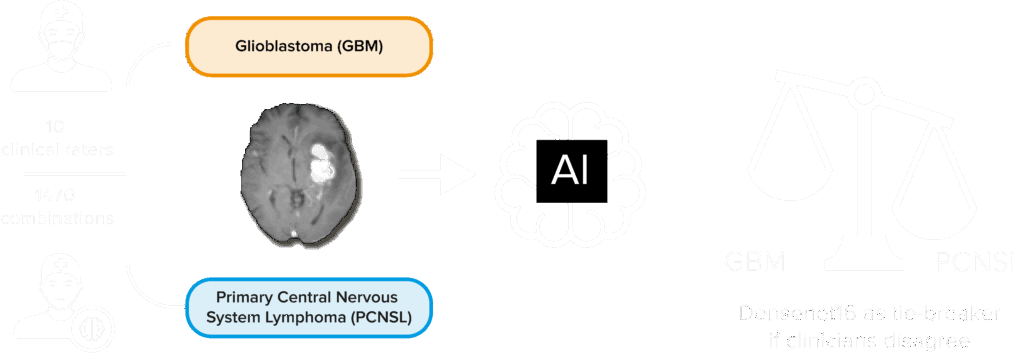
Building on the neural network (see development), the LINNDA project translated the concept into a clinically usable workflow. Instead of replacing clinicians, LINNDA positions AI as a tie-breaker: two clinicians independently assess the MRI, and only if their diagnoses differ does the CNN provide a decision. This simple rule mirrors real-world consensus processes while keeping full human oversight.
In a validation study of 46 cases (29 GBM, 17 PCNSL) assessed by 10 clinicians, LINNDA achieved a mean diagnostic accuracy above 90 %, raising the positive predictive value for GBM to 97.8 %. Neurosurgeons and radiologists performed equally well, and the network consistently corrected the most ambiguous cases. The approach demonstrates that selectively applied AI assistance can deliver large practical benefits.
Equally important, LINNDA avoids dependence on advanced imaging or heavy preprocessing: standard MRI data suffice. The project underscores that explainability and usability matter as much as raw performance. By integrating AI into existing review routines rather than creating parallel systems, LINNDA offers a safe, transparent path toward clinical adoption.